
Rough Cost Estimation of MES Implementation in a Factory (by Region)

Alex Niemczyk
—
12/9/2024
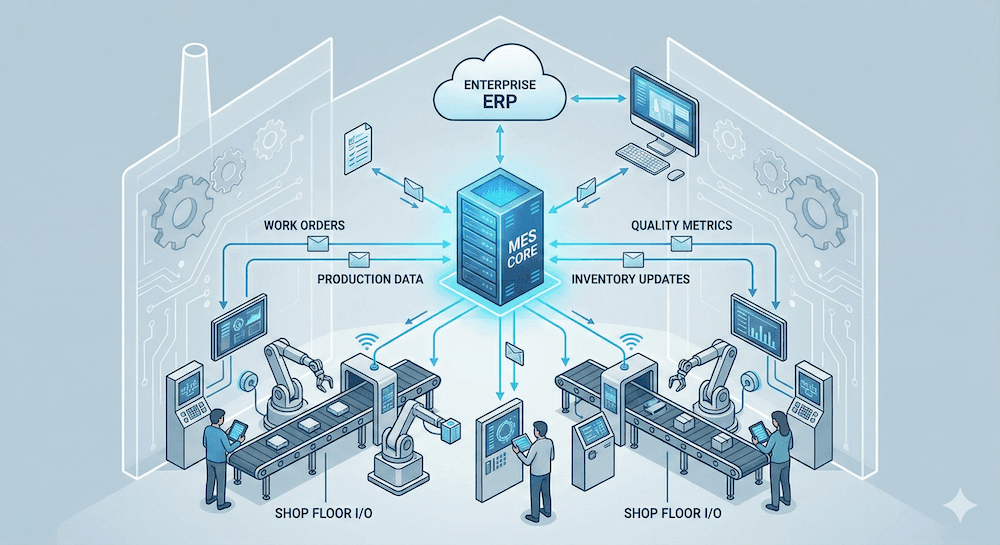
If you’re considering the implementation of a Manufacturing Execution System (MES) let's say across 10 production lines, you’re likely wondering: “What is a realistic early-stage budget?”
While MES projects vary based on industry, automation level, and number of integrations, global benchmarks allow us to estimate credible planning ranges.
It’s worth noting up front that many manufacturers today successfully implement leaner MES/OEE platforms at a fraction of traditional cost — especially when the main goal is real-time visibility, downtime monitoring, and performance management. Still, the comparison below shows what the market typically pays for full-scale MES deployments.
MES Cost Estimates by Region (10 Lines)
These ranges include software, implementation services, integrations, hardware, and training.
| Region / Cohort | Typical Cost Range (USD) | Approx. Cost per Line |
|---|---|---|
| EU (Western / Nordics / DACH / Benelux) | $600k – $1.20M | $60k – $120k |
| USA | $650k – $1.25M | $65k – $125k |
| South America | $400k – $900k | $40k – $90k |
| Ukraine | $350k – $800k | $35k – $80k |
| Turkey | $380k – $850k | $38k – $85k |
| Middle East (mainly GCC) | $450k – $1.00M | $45k – $100k |
| South East Asia | $350k – $800k | $35k – $80k |
Common Budget Breakdown (Typical MES)
For an "average" MES project (e.g., ~$800k in EU/US), the breakdown often looks like:
- Software licenses & maintenance: $150k – $300k
- Implementation services: $250k – $450k
- Integration development: $120k – $250k
- Infrastructure & hardware: $80k – $200k
- Training & change management: $50k – $100k
Most variation comes from services and integration work, not software licenses.
What Drives Costs Up or Down?
Projects lean to the lower end when:
- Cloud/SaaS deployment
- Standard functionality with limited tailoring
- Minimal integration scope
- Local integrators with competitive service rates
Projects reach the upper end when:
- On-prem environments with strict IT/security requirements
- Complex ERP/PLC/SCADA integrations
- Heavy customization or regulated industries
- High on-site presence or global consulting firms involved
How This Compares to OEE Tools Pricing
Many manufacturers today explore lighter-weight, faster-to-deploy alternatives to traditional MES when their priority is real-time performance visibility, OEE tracking, downtime analysis, and practical shop-floor data collection.
Here’s how the ranges above compare to the OEE Tools pricing model shown in the screenshot:
| Free | Professional | Enterprise | |
|---|---|---|---|
| Price | $0 / per work centre | $25 / per work centre | Custom |
| Included | Web dashboard, mobile app, master data, email support | All Free features + MQTT + HTTP API | All features + custom integrations + premium support |
| Integration Support | — | Basic integrations | Full integration scope |
| Usage Limits | 3 work centres, 3 users | Unlimited work centres & users | Unlimited |
Practical comparison:
- A 10-line deployment using the Professional plan costs roughly $250/month (or $3,000/year) — dramatically below traditional MES subscription and service costs.
- Since OEE Tools requires far less implementation effort, rollout can be incremental, starting with a few lines and expanding without large capital projects.
- It’s not a substitute for every MES function (e.g., deeply integrated workflows, complex batching logic), but it covers the core of what many manufacturers actually need: live production visibility, losses, downtime, and reporting.
This makes it a useful baseline if your goal is to validate benefits or start digitalization without immediately committing to a full MES investment.